In ‘Operation Red Card,’ D-FW police side with feds for FIFA 2026
North Texas law enforcement has a message for criminals ahead of the coming FIFA World Cup: Don’t even think about it.
Read more Lt. Gov. Dan Patrick endorses Mayes Middleton in Republican attorney general runoff

But after studying how 11 law enforcement leaders lined up at a dramatic joint news conference last week, The Watchdog had a different question:
Are they warning criminals — or unintentionally telling millions of soccer fans that North Texas is some kind of Crime Capital, USA?
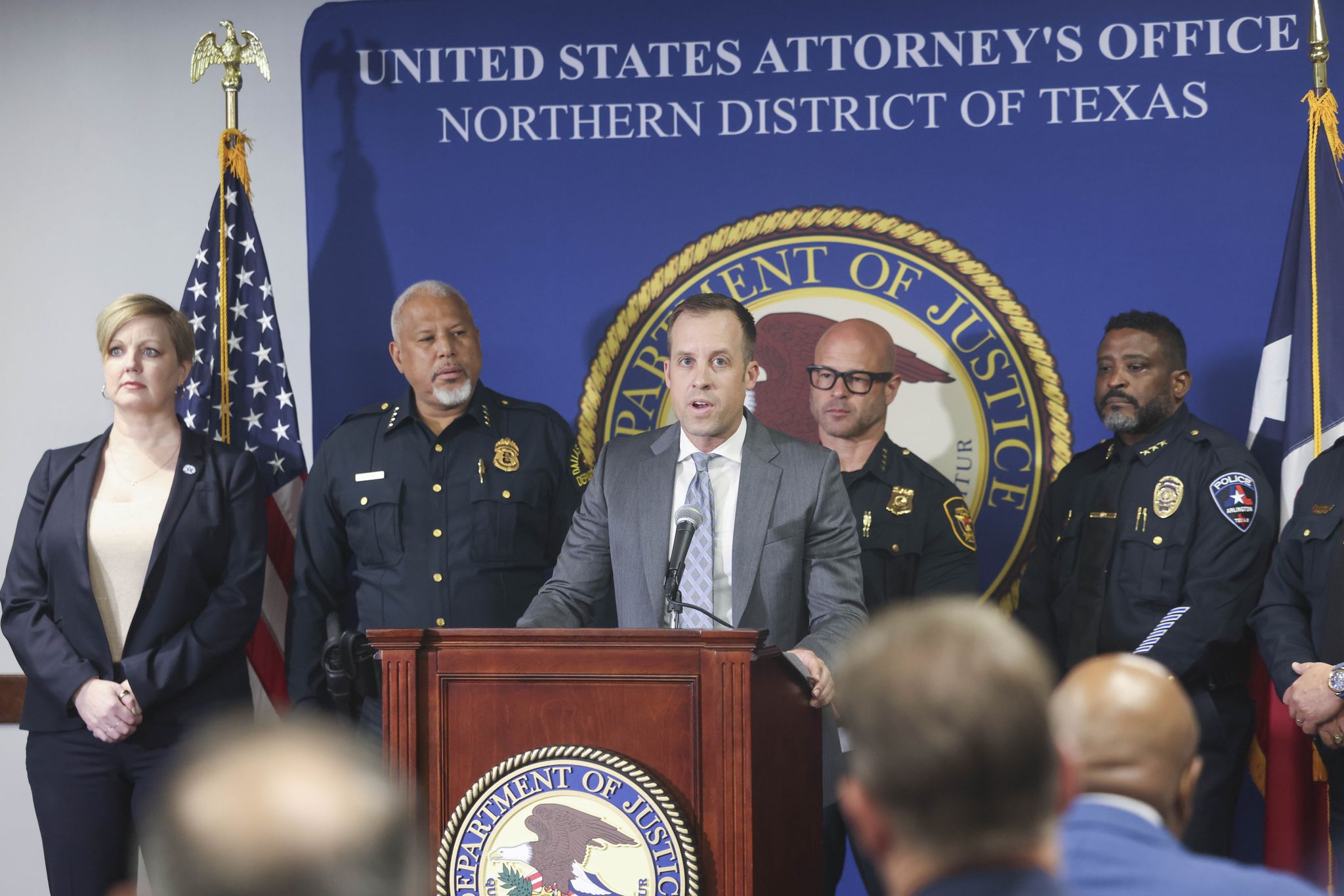
The officials gathered to announce “Operation Red Card,” a coordinated crackdown timed to the World Cup. In soccer, a red card sends a player off the field for a serious foul. In the law enforcement version, suspects skip local charges and face tougher federal prosecution.
And judging by the lineup — police chiefs from Fort Worth, Dallas, Arlington and Mansfield, flanked by the FBI, Homeland Security, ATF, DEA, postal inspectors and federal prosecutors — North Texas must either be the safest host city in America… or the one most eager to prove it.
And that’s what makes this such a fascinating spectacle.
Don’t let Google decide who you trust.
The officials stood shoulder to shoulder to deliver two messages.
First: If you come here to rob, traffic, deal drugs, kidnap or prey on visitors during the World Cup, you’re not just getting arrested — you may find yourself facing the full weight of the federal justice system.
Second: Look what happens when we all work together.
The Watchdog supports both goals. If organized criminals see North Texas as a target-rich environment during an international sporting event, law enforcement should hit back hard.
But here’s the uncomfortable question: Why does it take the world’s biggest soccer tournament to bring this kind of firepower to the field?
Operation Red Card began March 14 and is scheduled to continue until June 14 — the day the first World Cup match is played. That’s a three-month surge involving police chiefs from four cities, federal agents from nearly every major alphabet agency and prosecutors from the U.S. Attorney’s office.
If this level of coordination works now, why stop when the games begin? Why not keep it going through the tournament — or better yet, make it permanent?
Because if 11 agencies working side by side can arrest more than 130 suspects, seize 81 firearms and confiscate 116 kilograms of methamphetamine, cocaine and fentanyl before the first kickoff, imagine what they could do if they played this way year-round.
Why does it take an international sports competition to bring everyone together for such an operation?
Don’t stop
If law enforcement believes North Texas needs this kind of all-hands-on-deck police surge before the games begin, why stop once 3.8 million visitors actually start arriving?
That’s the projected crowd, according to economic forecasters — 3.8 million visitors pouring into North Texas, with an estimated regional impact of $1.5 billion to $2.1 billion.
The Watchdog has questions about numbers like these. Who decides 3.8 million? How do economists predict what millions of tourists will spend before they’ve even packed their bags?
Read more For the first time, the FBI is tracking AI scams. The losses are already massive
Yet these forecasts shape everything — from hotel rates to traffic planning to, apparently, federal crime strategy.
Unexpected outcomes
I’ve covered enough mega-events to know that projections about crowds and spending can be a dangerous game. The numbers always sound impressive — millions of visitors, billions in economic impact, overflowing hotels, packed restaurants.
And then… life happens.
I’ll give you three examples.
In 1976, Philadelphia was staging its bicentennial celebration of America’s 200th birthday. The city expected 100 million visitors to spend millions of dollars. Then Mayor Frank Rizzo publicly warned of possible violent protests and asked the federal government to send in 15,000 federal troops, a request that was denied.
With a torrent of negative publicity, the damage was done. The request killed the party. People feared violence. On July Fourth, that day, I couldn’t find any protestors. And there weren’t a lot of tourists either.
Twenty years later, I covered the 1996 Summer Olympics in Atlanta. Organizers were counting on millions of visitors and millions of dollars.
Then a bomb exploded in Centennial Olympic Park.
That changed the mood instantly.
Then came the 2011 Super Bowl here in North Texas. Tons of visitors were expected to empty their wallets to the tune of $50 million. But no one saw that ice storm coming or the snow and ice falling off the stadium roof and injuring people.
Sportswriter Richie Whitt gave the final score: Packers 31, Steelers 25, North Texas 0.
Price gouging
Now there’s another area where visitors might welcome a crackdown of law enforcement: price gouging.
That’s not part of Operation Red Card.
FIFA World Cup game tickets, as you probably heard, can jump as high as $10,000.
Transportation costs are another problem.
New Jersey Transit is charging exorbitant prices for a round-trip train ticket from Manhattan to MetLife Stadium in the Meadowlands — $150 for what is usually about $13.

Catch up on the latest news and top stories from across North Texas, with updates in the morning and evening.
By signing up, you agree to our Terms Of Use and acknowledge that your information will be used as described in our Privacy Policy.
In Boston, a round-trip bus ticket will go for $95.
Locally, we’re doing much better. With a GoPass, you can go from downtown Dallas or downtown Fort Worth via train and then finish the trip to the stadium on free shuttle buses.
With all this talk about high prices and criminal activities, it’s easy to lose sight of the point: soccer is supposed to be a beautiful game.
Read more To strengthen North Texas’ food system, Dallas group turns to healthcare solution